CTMPR

Concise Training For A More Profitable Retirement!

Investing In Metals Can Be Treacherous!

I have always loved trading precious metals because they are very technically oriented (especially silver) and you can often find patterns that consistently work. However, there are times when they become so volatile that it’s best just to get out of the way. This year we have had several examples of that type of volatility.

Silver went parabolic in March blasting to it’s all time high at nearly $50. At the time I heard of several people putting up to 50% of their retirement accounts into the silver etf (SLV). I felt sorry for them when the market turned and plunged to $30 giving back almost all of the gain in a matter of days. The entire “giveback” was completed recently in the massive “Risk Off” liquidation sending silver futures back to their January low of $26.

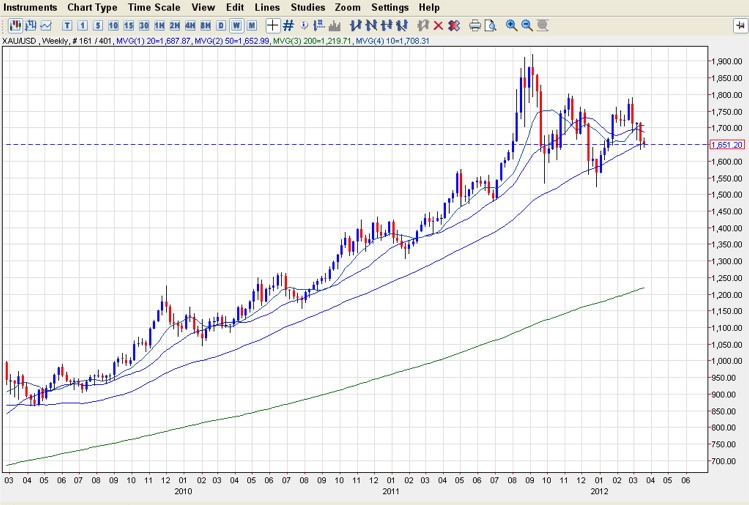
Next it was gold’s turn to go parabolic (in July) blasting to new all time highs, making a double top and giving then retracing most of it in a few days. Gold is still up significantly on the year but I’m not so sure we are completely out of the woods yet.

The biggest loser so far in 2011 has been copper & especially copper stocks. In fact, if you look at the following chart of copper futures you can see that it’s down nearly 25% since the beginning of the year. Copper prices are the most economically sensitive of the 3 so it makes sense that it’s had a tough year. If we actually slide into another recession there is probably another 25% downside in copper.

If you look at the daily chart of the most popular copper etf (COPX) which is made up of copper stocks you can see the carnage is even more severe. COPX was down nearly 50% for the year before the reversal on Monday.

We are in an environment where the short term pressures are deflation and recession but everyone expects monetary lead inflation in the long term. This leads to a very volatile environment. This is why it’s best to limit metals to about 10% of your overall investment portfolio, otherwise volatility can keep you up at night!

Investing In Copper Using And ETF / ETN Strategy

At this time there are 5 exchange traded vehicles with exposure to copper. Despite much chatter and speculation in late 2010 that both iShares and JPMorgan were going to launch physical copper etfs there is still nothing available.

The only one option for tracking the actual price of copper is the iPath Dow Jones-UBS Copper ETN (JJC)

Even though it’s an ETN instead of a Copper ETF it is the most direct way to track the price of copper. This ETN basically tracks copper prices using the High Grade Copper Futures contract which trades on the COMEX. Since it uses futures, it does carry the risk of contango causing roll-over losses but this has generally been a much smaller problem in the metals than in oil and natural gas. Since this fund is an ETN it is basically a senior debt issued by Barclay’s so it does contain counter party risk. This became an issue during the credit meltdown in 2008 but doesn’t pose much of a threat in normal times.

Its expense ratio is 0.75% (75 basis points) and the symbol is JJC.

First Trust ISE Global Copper Index ETF (CU)

This ETF was the first of 3 based on copper related mining stocks. It tracks the ISE Global Copper Index so it consists of copper mining companies as well as extractors of other metals so it is not a pure play.

They attempt to compensate for this by weighting each company according to the level of copper exposure they have and the percentage of revenues derived from copper. Geographically, it includes companies in the developed countries with 1/2 the exposure in Canada and the UK.

Its expense ratio is 0.70% (70 basis points) this copper ETF symbol is CU.

Global X Copper Miners ETF (COPX)

The COPX copper etf tracks the Solactive Global Copper Miners Index, which consists of stocks for companies that focus purely on copper mining. There are several companies that overlap with CU but COPX has more smaller mining companies. Geographical this ETF is more concentrated in Canada and the UK making up 2/3 of the exposure.

Its expense ratio is 0.65% (65 basis points) and the copper ETF symbol is COPX.

Emerging Global Shares Emerging Markets Metals & Mining ETF (EMT)

Once again, this is a stock-based ETF that invests in mining and extraction companies but includes companies that mine nickel, gold and platinum in addition to copper. Copper makes up about 50% of the metal produced by these companies. Another major difference is that this ETF focuses on miners that are in emerging markets.

A majority of the miners making up the Dow Jones Emerging Markets Metals & Mining Titans Index tracked by this ETF are located in China and Brazil, with a significant presence in South Africa as well.

Its expense ratio is 0.85% (85 basis points) and this copper ETF trading symbol is EMT.

This is a good place to start when looking to invest in copper, there will most likely be additional “physical” copper ETFs coming to market sometime, but it seems to be taking some time.

Investing In Silver – A Beginners Guide

Silver had one of the most spectacular runs from September 2010 to April 2011 in the history of commodity markets. When silver gains momentum there are few other markets that can perform in such a spectacular fashion. Even after the spectacular run it had in 2011 there are many silver bulls out there who believe we are ultimately headed for $100+. If you want to participate in the silver market there are several different ways to do it.

#1 – Silver Futures (Comex & Mini)

This was my first introduction to silver back in 1988 when silver had a nice rally following the 1988 drought. At the time I bought an option on Comex Silver Futures and went on a wild ride. Back then however a $3 or 4 move was pretty substantial and didn’t happen on a weekly basis like it does today. The two different futures contracts that are available are the 5000 ounce Comex Silver contract that trades on the CME and the 1000 ounce E-Mini contract that trades on NYSE/Liffe. Both are viable trading vehicles with plenty of liquidity.

#2 – Silver Coins

This was the second way I purchased silver in 1989, unfortunately I bought too high in the quality structure (MS 65-66) and paid way too much. If you are buying simply for the value of the actual silver I would buy junk silver (pre-1965 coins) that contain roughly 90% silver. The other way to go is to purchase silver bars that come in a variety of sizes. Check prices at reputable online dealers before you venture out to local dealers, that way you will know the spreads ahead of time. There are lots of great dealers but plenty of crooks as well.

#3 – Silver ETFs

The explosion in popularity of SLV – the largest silver etf as well as the Physical Silver ETF (SIVR) and the Sprott Physical Closed End Fund had a lot to do with the sharp run up in silver. In the weeks leading up to the top I had heard from several different sources of people who were putting large chunks of their retirement accounts into the SLV. These ETFs generally move penny for penny with the price of silver so they are very volatile compared to the stock market. If you crave even more volatility, ProShares offers the Double Silver ETF (AGQ) as well as a Double Short Silver ETF (ZSL). Be careful with these as they are designed to be trading tools and not held as long term investments.

#4 – Silver Mining Stocks

My favorite silver mining stock is Silver Wheaton – SLW because they are not actually a mining company. They buy silver from other mining companies that produce it as a by product of copper mining etc. They typically pay low prices ($4-5) on a long term contract, so they have tremendous leverage as the price of silver rises. Since they have no mining risks or production cost risk it tends to eliminate some of the company specific problems that can plague mining stocks. The other way I like to play silver mining stocks is by using SIL which is a silver mining etf that is made up of all the major global silver mining companies. Mining companies tend to be leveraged to the price of silver so they can outperform when prices are rising but tend to under perform when prices are falling.

As you can see there are many different ways to purchase silver and it basically comes down to why you want to own it. If you are planning for the end of the monetary system, then it’s best to own the actual physical silver. If you are buying it to profit from a price rise, I prefer the mini futures contract as you can hold 1000 ounces for just a few thousand dollars. Just don’t over extend yourself, that’s the quickest way to get in trouble in the silver market. It’s definitely not a place for the faint of heart!